Minggu, 19 Desember 2010

[U669.Ebook] Fee Download Primates and Philosophers: How Morality Evolved (Princeton Science Library), by Frans de Waal

Fee Download Primates and Philosophers: How Morality Evolved (Princeton Science Library), by Frans de Waal

Sooner you obtain the publication Primates And Philosophers: How Morality Evolved (Princeton Science Library), By Frans De Waal, faster you can appreciate checking out the e-book. It will certainly be your resort to keep downloading and install guide Primates And Philosophers: How Morality Evolved (Princeton Science Library), By Frans De Waal in offered web link. In this means, you can actually make a selection that is worked in to obtain your very own publication on the internet. Below, be the initial to get guide qualified Primates And Philosophers: How Morality Evolved (Princeton Science Library), By Frans De Waal and be the first to understand just how the writer indicates the notification and also knowledge for you.
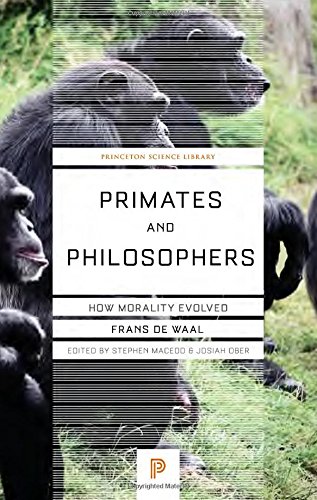
Primates and Philosophers: How Morality Evolved (Princeton Science Library), by Frans de Waal

Primates and Philosophers: How Morality Evolved (Princeton Science Library), by Frans de Waal


Primates and Philosophers: How Morality Evolved (Princeton Science Library), by Frans de Waal

Fee Download Primates and Philosophers: How Morality Evolved (Princeton Science Library), by Frans de Waal

Primates And Philosophers: How Morality Evolved (Princeton Science Library), By Frans De Waal. Learning how to have reading routine is like learning how to attempt for consuming something that you actually do not desire. It will require more times to help. In addition, it will certainly also bit force to serve the food to your mouth as well as ingest it. Well, as checking out a publication Primates And Philosophers: How Morality Evolved (Princeton Science Library), By Frans De Waal, occasionally, if you need to check out something for your brand-new works, you will certainly feel so dizzy of it. Also it is a book like Primates And Philosophers: How Morality Evolved (Princeton Science Library), By Frans De Waal; it will make you feel so bad.

This Primates And Philosophers: How Morality Evolved (Princeton Science Library), By Frans De Waal is extremely appropriate for you as novice user. The readers will certainly consistently begin their reading routine with the favourite style. They may not consider the author and author that develop the book. This is why, this book Primates And Philosophers: How Morality Evolved (Princeton Science Library), By Frans De Waal is really ideal to review. Nonetheless, the concept that is given in this book Primates And Philosophers: How Morality Evolved (Princeton Science Library), By Frans De Waal will certainly show you numerous points. You could begin to love also checking out until the end of the book Primates And Philosophers: How Morality Evolved (Princeton Science Library), By Frans De Waal.

On top of that, we will certainly discuss you the book Primates And Philosophers: How Morality Evolved (Princeton Science Library), By Frans De Waal in soft file kinds. It will certainly not disturb you making heavy of you bag. You require only computer gadget or gadget. The web link that we offer in this website is available to click and then download this Primates And Philosophers: How Morality Evolved (Princeton Science Library), By Frans De Waal You know, having soft file of a book Primates And Philosophers: How Morality Evolved (Princeton Science Library), By Frans De Waal to be in your device can make reduce the readers. So through this, be a great visitor now!

Simply link to the internet to get this book Primates And Philosophers: How Morality Evolved (Princeton Science Library), By Frans De Waal This is why we mean you to make use of and also use the developed innovation. Reviewing book doesn't imply to bring the published Primates And Philosophers: How Morality Evolved (Princeton Science Library), By Frans De Waal Created modern technology has actually allowed you to check out only the soft data of the book Primates And Philosophers: How Morality Evolved (Princeton Science Library), By Frans De Waal It is very same. You could not should go and get conventionally in looking the book Primates And Philosophers: How Morality Evolved (Princeton Science Library), By Frans De Waal You may not have sufficient time to spend, may you? This is why we provide you the best way to get the book Primates And Philosophers: How Morality Evolved (Princeton Science Library), By Frans De Waal currently!

Primates and Philosophers: How Morality Evolved (Princeton Science Library), by Frans de Waal

Can virtuous behavior be explained by nature, and not by human rational choice? "It's the animal in us," we often hear when we've been bad. But why not when we're good? Primates and Philosophers tackles this question by exploring the biological foundations of one of humanity's most valued traits: morality.

In this provocative book, renowned primatologist Frans de Waal argues that modern-day evolutionary biology takes far too dim a view of the natural world, emphasizing our "selfish" genes and reinforcing our habit of labeling ethical behavior as humane and the less civilized as animalistic. Seeking the origin of human morality not in evolution but in human culture, science insists that we are moral by choice, not by nature.

Citing remarkable evidence based on his extensive research of primate behavior, de Waal attacks "Veneer Theory," which posits morality as a thin overlay on an otherwise nasty nature. He explains how we evolved from a long line of animals that care for the weak and build cooperation with reciprocal transactions. Drawing on Darwin, recent scientific advances, and his extensive research of primate behavior, de Waal demonstrates a strong continuity between human and animal behavior. He probes issues such as anthropomorphism and human responsibilities toward animals. His compelling account of how human morality evolved out of mammalian society will fascinate anyone who has ever wondered about the origins and reach of human goodness.

Based on the Tanner Lectures de Waal delivered at Princeton University's Center for Human Values in 2004, Primates and Philosophers includes responses by the philosophers Peter Singer, Christine M. Korsgaard, and Philip Kitcher and the science writer Robert Wright. They press de Waal to clarify the differences between humans and other animals, yielding a lively debate that will fascinate all those who wonder about the origins and reach of human goodness.

  • Sales Rank: #558622 in Books
  • Brand: imusti
  • Published on: 2016-03-22
  • Original language: English
  • Number of items: 1
  • Dimensions: .70" h x 5.40" w x 8.40" l, .0 pounds
  • Binding: Paperback
  • 232 pages
Features
  • University Press Group Ltd

From Publishers Weekly
Celebrated primatologist de Waal expands on his earlier work in Good Natured: The Origins of Right and Wrong in Humans and Other Animals to argue that human traits of fairness, reciprocity and altruism develop through natural selection. Based on his 2004 Tanner Lectures at Princeton, this book argues that our morality grows out of the social instincts we share with bonobos, chimpanzees and apes. De Waal criticizes what he calls the "veneer theory," which holds that human ethics is simply an overlay masking our "selfish and brutish nature." De Waal draws on his own work with primates to illustrate the evolution of morality. For example, chimpanzees are more favorably disposed to others who have performed a service for them (such as grooming) and more likely to share their food with these individuals. In three appendixes, de Waal ranges briefly over anthropomorphism, apes and a theory of mind, and animal rights. The volume also includes responses to de Waal by Robert Wright, Christine M. Korsgaard, Philip Kitcher and Peter Singer. Although E.O. Wilson and Robert Wright have long contended that altruism is a product of evolution, de Waal demonstrates through his empirical work with primates the evolutionary basis for ethics. (Oct.)
Copyright � Reed Business Information, a division of Reed Elsevier Inc. All rights reserved.

From Scientific American
It was not until a year and a half after his voyage on board the Beagle that Charles Darwin first came face to face with an ape. He was standing by the giraffe house at the London Zoo on a warm day in late March of 1838. The zoo had just acquired an orangutan named Jenny. One of the keepers was teasing her—showing her an apple, refusing to hand it over. Poor Jenny "threw herself on her back, kicked & cried, precisely like a naughty child," Darwin wrote in a letter to his sister. In the secret notebooks that he kept after the voyage, Darwin was speculating about evolution from every angle, including the emotional, and he was fascinated by Jenny’s tantrum. What is it like to be an ape? Does an orangutan’s frustration feel a lot like ours? Might she cherish some sense of right and wrong? Will an ape despair because her keeper is breaking the rules—because he is just not playing fair? Our own species has been talking, volubly and passionately, for at least 50,000 years, and it’s a fair guess that arguments about right and wrong were prominent in our conversation pretty much from the beginning. We started writing things down 5,000 years ago, and some of our first texts were codes of ethics. Our innumerable volumes of scripture and law, our Departments of Justice, High Courts, Low Courts, and Courts of Common Pleas are unique in the living world. But did we human beings invent our feeling for justice, or is it part of the package of primal emotions that we inherited from our ancestors? In other words: Did morality evolve? Dutch-born psychologist, ethologist and primatologist Frans de Waal has spent his career watching the behavior of apes and monkeys, mostly captive troupes in zoos. As a young student, he sat on a wooden stool day after day for six years, observing a colony of chimpanzees at the Arnhem Zoo. Today he watches chimpanzees from an observation post at Emory University’s Yerkes National Primate Research Center in Atlanta and at other zoos and primate centers. His work, along with primatologist Jane Goodall’s, has helped lift Darwin’s conjectures about the evolution of morality to a new level. He has documented tens of thousands of instances of chimpanzee behavior that among ourselves we would call Machiavellian and about as many moments that we would call altruistic, even noble. In his scientific papers and popular books (including Chimpanzee Politics, Our Inner Ape and Good Natured), he argues that Darwin was correct from that first glimpse of Jenny at the zoo. Sympathy, empathy, right and wrong are feelings that we share with other animals; even the best part of human nature, the part that cares about ethics and justice, is also part of nature. De Waal’s latest book, Primates and Philosophers, is based on the Tanner Lectures that he delivered at Princeton University’s Center for Human Values in 2004. In this book he tries—as he has many times before—to refute a popular caricature of Darwinism. Many people assume that to be good, be nice, behave, play well with others, we have to rise above our animal nature. It’s a dog-eat dog world out there—or, as the Romans put it, homo homini lupus, man is wolf to man (a curious proverb for a people whose founding myth was the suckling by a wolf of the infant twins Romulus and Remus). Thomas Henry Huxley, Darwin’s self-appointed bulldog, promoted this dark, cold view of life in a famous lecture, Evolution and Ethics. "The ethical progress of society depends, not on imitating the cosmic process, still less in running away from it, but in combating it," he declared. In Fyodor Dostoyevsky’s The Brothers Karamazov, Ivan puts it another way: if there is no God, then we are lost in a moral chaos. "Everything is permitted." De Waal calls this "Veneer Theory." In this view, human morality is a thin crust on a churning urn of boiling funk. In reality, de Waal reminds us, dogs are social, wolves are social, chimps and macaques are social, and we ourselves are "social to the core." Goodness, generosity and genuine kindness come just as naturally to us as meaner feelings. We didn’t have to invent compassion. When our ancestors began writing down the first codes of conduct, precepts, laws and commandments, they were elaborating on feelings that evolved thousands or even millions of years before they were born. "Instead of empathy being an endpoint," de Waal writes, "it may have been the starting point." Back in the 1950s and 1960s, when animal psychologists talked about "sympathy" and "empathy," they always put those words between quotation marks, de Waal notes. Now he wants to take away the quotation marks. He describes one of his best-known demonstrations that animals care about fairness. In the experiment, he had pairs of capuchin monkeys perform simple tasks in their cages. For successfully completing each task they would get a reward, sometimes a slice of cucumber, sometimes a grape. All the monkeys would work for and eat the cucumber slices, but they preferred grapes. If one monkey kept getting paid in cucumber and it could see that its partner in the next cage was getting grapes, it would get mad, like Darwin’s Jenny. After a while the monkey would refuse to eat or throw the cucumber right out of the cage. Is de Waal right about all this? In the second half of Primates and Philosophers, his arguments are critiqued by a series of commentators, all of whom have written important studies of evolutionary ethics. They cite Freud, Kant, Hume, Nietzsche and Adam Smith. They circle and circle around those pairs of capuchin monkeys: "A capuchin rejects a cucumber when her partner is offered a grape—is she protesting the unfairness, or is she just holding out for a grape?" writes Christine M. Korsgaard, Arthur Kingsley Porter Professor of Philosophy at Harvard University. "Of course, if the lucky capuchin were to throw down the grape until his comrade had a similar reward, that would be very interesting!" writes Philip Kitcher, John Dewey Professor of Philosophy at Columbia University. They disagree, they discuss, they bicker a little, like all primates and philosophers. They illuminate not only ageless questions of ethics but also current concerns such as the Geneva convention and "why universal empathy is such a fragile proposal," as de Waal writes in his response to his critics. By the end of the book it seems clear that we can no longer look at morality as a sort of civilized veneer on a cold and selfish animal, even though that view goes back long before Darwin went to the zoo. Its origin lies in the Western concept of original sin—when Adam and Eve ate their first apple.

Jonathan Weiner won a Pulitzer Prize in 1995 for The Beak of the Finch. He teaches science writing in Columbia University’s Graduate School of Journalism.

From Booklist
Primatologist de Waal's career has been devoted to demonstrating that nature isn't utterly red in tooth and claw. His Tanner Lectures in Human Values argue that for the great apes and humans, in particular, morality isn't a veneer masking self-interest. It is intrinsic, the evolutionary outcome of the fact that altruism is conducive to species survival. Darwin, who saw no "conflict between the harshness of the evolutionary process and the gentleness of some of its products" and who affirmed the developmental similarity of species, including humans, essentially held the same position, de Waal says, being influenced toward it by Scottish moral philosopher Adam Smith. There is more to de Waal's exceptionally rich but always lucid paper, notably including an appendix, one of three, on animal rights. Four philosophers--one the controversial ethicist and advocate for animals Peter Singer--critique aspects of de Waal's argument, and in conclusion, de Waal responds to them. Intellectual soul food for biology-minded ethicists, in particular. Ray Olson
Copyright � American Library Association. All rights reserved

Most helpful customer reviews

8 of 8 people found the following review helpful.
A great (and brief) read into the issue of Morality.
By Amazon Customer
This is a great book if only because it provides views from five different scholars. "In the Tanner Lectures on Human Values that became the lead essay in this book, Frans de Waal brings his decades of work with primates, and his habit of thinking deeply about the meaning of evolution, to bear upon a fundamental question about human morality. Three distinguished philosophers and a prominent student of evolutionary psychology then respond to the way de Waal's question is framed, and to his answer. Their essays are at once appreciative of de Waal's endeavor and critical of certain of his conclusions. De Waal responds to his critics in an afterword."

The main thrust of de Waal's essay is what he calls "Veneer Theory," which is the argument that morality is only a thin veneer overlaid on an amoral or immoral core. The first to respond is Robert Wright (The Moral Animal: Evolutionary Psychology and Everyday Life), who states that he is in fact not an adherent to de Waal's Veneer Theory. Second is Christine M. Korsgaard (Self-Constitution: Agency, Identity, and Integrity), who denies that Veneer Theory is even real. Third is Philip Kitcher (Living with Darwin: Evolution, Design, and the Future of Faith (Philosophy in Action)), who generally attacks Veneer Theory as not being relevant to bridging the divide between primates and humans. The fourth, last, and my personal favorite, comes from Peter Singer (The Life You Can Save: Acting Now to End World Poverty). Singer, I believe, does the greatest justice to the entire argument and I happen to agree with almost everything he says. Singer states, "The issue, then, is not so much whether we accept the Veneer Theory of morality, but rather how much of morality is veneer, and how much is underlying structure. Those who claim that all of morality is a veneer laid over a basically individualistic, selfish human nature, are mistaken. Yet a morality that goes beyond our own group and shows impartial concern for all human beings might well be seen as a veneer over the nature we share with other social mammals."

In conclusion, I think this is a valuable book and do recommend it. I would also recommend getting Michael Tomasello's Why We Cooperate (Boston Review Books) as it is similar in nature and style. Lastly, I would also mention that Frans de Waal mentions a research experiment in which he "demonstrates" primate empathy, but as Tomasello points out, "But studies [contra de Waal] from three different laboratories in the case of the capuchins, and from our laboratory in the case of the chimpanzees, have all found that this is a spurious result in that it does not depend on a social comparison at all. One of the studies found that simply seeing and expecting to receive the grape makes the cucumber look less attractive to chimpanzees. No other individuals need to be around. There is no social comparison going on, only food comparison. So nothing related to norms of fairness are at work either (pg. 32)." Hope that helps.

32 of 34 people found the following review helpful.
Some weak arguments and straw men
By Adam D. Shomsky
Primates and Philosophers is not a comprehensive analysis of the origins of morality, but focuses on one minutia of the subject: whether human morality goes deep into our evolutionary past or is new with the arrival of our bulbous brains and cultures. The answer depends on how morality is defined. If moral behavior falls under the definition of morality, it seems clear that other primates such as chimps share at least rudimentary moral behavior. But if morality is defined as abstract thinking about right and wrong and living by principles derived abstractly, then morality must be pretty recent in humans' evolutionary past.

De Waal quotes Richard Dawkins as saying "we, alone on earth, can rebel against the tyranny of the selfish replicators" and "[we are] nicer than is good for our selfish genes." De Waal takes this as lending support of what he calls 'veneer theory', the position that morality is "a cultural overlay, a thin veneer hiding an otherwise selfish and brutish nature." Having read seven of Richard Dawkins' books, I feel like I understand his views pretty well, and I don't think he would agree with veneer theory at all. I think there is some ambiguity here between proper domain vs. actual domain. The proper domain is the conditions under which a behavior evolved, and the actual domain is the conditions under which the behavior is manifest. Sometimes they are the same, sometimes not. For example, the proper domain of a moth's light-sensitive navigation system is a light source in the dark that an ancient moth would have encountered, such as the moon. But today, the actual domain may be a light bulb, candle, or bug zapper. The navigation system doesn't work correctly when the source of light is nearby, and it causes moths to spiral into light sources, sometimes to their deaths. Our genes (and moth genes) provide rules-of-thumb that aren't necessarily survival-enhancing in every conceivable actual domain; it is only necessary that these rules were useful on average to our ancestors in our evolutionary past. So saying that we are "nicer than is good for our selfish genes" in the world we currently live in, which is much different than our evolutionary past, is not to imply some mysterious cause outside of nature accounts for this deviation. Similarly, every time we use contraception we are "rebelling against the tyranny of the selfish replicators" because the proper domain (in the technical sense) of sex is procreation, but the actual domain may be recreation. Having as many offspring as possible would be beneficial to our genes, but we can obviously choose not to do so.

In a table on page 22, de Waal compares veneer theory to his own theory of the evolution of ethics. Under veneer theory, he lists Richard Dawkins as an advocate and states that the empirical evidence in favor of that theory is "none." This is a textbook straw man, and I am confident that at least one of the alleged "advocates" is no advocate at all.

On the next page, de Waal hastily concludes that Steven Pinker's brilliant work on human language skills requires "postulating discontinuities" in evolution and thus is saltatory. Apparently he takes it as self-evident that a language module in the brain cannot possibly evolve by gradual degrees, although I'm baffled as to why he thinks that.

In Christine Korsgaard's section, she writes "it is absurd to think that nonhuman animals are motivated by self-interest...acting for the sake of your best interests requires the capacity to be motivated by the abstract conception of your overall long-term good." [p 102] Self interest, I think, can be pretty simply defined as the most effective way of spreading your genes. There is no need to have a conscious conception of what that consists of because the genes that program the best gene-spreading behavior are automatically propagated. I found Korsgaard's chapter to be lacking in scientific rigor. She seemed to make conclusions about empirical questions based on casual observation and reasoning. However, she did provide a clear definition of morality which was lacking from de Waal's part.

In Phillip Kitcher's section, he defines four dimensions of 'altruism space': intensity (the degree to which one meets the needs or desires of others), range (how high can the stakes get before one acts selfishly), extent (the set of individuals one acts altruistically toward), and skill (ability to discern the desires of the beneficiary). He agrees that non-human primate morality lies somewhere in the defined 'altruism space' away from pure selfishness, but until we have a clear definition of the ideal moral individual with respect to these four dimensions, "it's premature to claim that human morality is a 'direct outgrowth' of tendencies [non-human primates] share." [p 129] But if non-human primate morality differs by degree and not by kind (as implied here) is it not reasonable to conjecture that human morality is a direct outgrowth of the tendencies of primates?

Kitcher goes on to say that when chimpanzees are faced with an opportunity for altruism, their impulses for selfishness and altruism duke it out and they are ultimately "vulnerable to whichever impulse happens to be dominant at a particular moment." But I am far from convinced that humans are much different. Since when have we humans overcome our impulses? As Peter Singer argues later in the book, our emotional impulses constitute a large part of our morality. In those rare cases where abstract thinking overturns our gut reactions to moral questions, one could argue we are not acting on impulse but on reason. But those cases probably represent a vast minority of moral judgments. As de Waals mentioned, moralistic and altruistic intuitions come from deep in the evolutionarily ancient part of the brain, and conscious rationalization of those intuitions does not mean we've overcome them. Steven Pinker has revealed a world in which unconscious brain processes have profound impacts on our thoughts and decisions even though, by definition, we don't notice them. But we surely notice when they're gone, such as in people who have suffered damage to various parts of the brain, leaving certain parts of the intellect unscathed while some capacities are completely destroyed.

Peter Singer's section was the highlight of this book. I found his section better-argued than the others and his explanations more compelling. "Like the other social mammals, we have automatic, emotional responses to certain kinds of behavior, and these responses constitute a large part of our morality. Unlike the other social mammals, we can reflect on our emotional responses, and choose to reject them." [p 149] "Perhaps we do so only on the basis of other emotional responses, but the process involves reason and abstraction." Singer points out that this ability to reflect and abstract is evolved not just to make moral choices but is useful in many other parts of life as well.

22 of 23 people found the following review helpful.
Excellent discussion on the nature/nurture origin of morality
By J. R. Valery
In a series of lectures, De Waal attacks the notion that human morality is just a thin veneer of recent invention provided by the intellect, which barely hides a brutal animal, and is unique to humans. He supports his attack with data and observations from his own and from other scientists' research on primates, particularly on capuchin monkeys, chimpanzees and bononbos.

Robert Wright, Christine Koorsgard, Philip Kitcher and Peter Singer respond to De Waal's arguments with their own observations, and De Waal responds with an final argument to close the book.

Most of the counterarguments agree with DeWaal's hypothesis that the basis of morality can be observed time and again in other species, and that empathy, sympathy and the rudiments of self-sacrifice are already present in the higher primates. They criticize De Waal's oversimplification of their positions. However Koorsgard, with the longest and densest response entry, seems recursive, and her final position is not clearly far from "veneer theory".

This book, along with the previous books and journal articles by Frans De Waal and other scientists and philosophers, adds tremendous weight to the idea that by studying other species, especially our closest relatives, we can understand much more about our psychology, our cognitive abilities (including morality), and our place in nature.

However, this is not the best book for those who want to start getting information about this subject. De Waal's "Chimpanzee Politics", "Good Natured", "Peacemaking Among Primates", "Our Inner Ape" and "Bonobo: The Forgotten Ape" are much better starters into De Waals research and hypotheses.

See all 25 customer reviews...

Primates and Philosophers: How Morality Evolved (Princeton Science Library), by Frans de Waal PDF
Primates and Philosophers: How Morality Evolved (Princeton Science Library), by Frans de Waal EPub
Primates and Philosophers: How Morality Evolved (Princeton Science Library), by Frans de Waal Doc
Primates and Philosophers: How Morality Evolved (Princeton Science Library), by Frans de Waal iBooks
Primates and Philosophers: How Morality Evolved (Princeton Science Library), by Frans de Waal rtf
Primates and Philosophers: How Morality Evolved (Princeton Science Library), by Frans de Waal Mobipocket
Primates and Philosophers: How Morality Evolved (Princeton Science Library), by Frans de Waal Kindle

Primates and Philosophers: How Morality Evolved (Princeton Science Library), by Frans de Waal PDF

Primates and Philosophers: How Morality Evolved (Princeton Science Library), by Frans de Waal PDF

Primates and Philosophers: How Morality Evolved (Princeton Science Library), by Frans de Waal PDF

Jumat, 17 Desember 2010

[Z977.Ebook] PDF Download Introduction to Scientific Visualization, by Helen Wright

PDF Download Introduction to Scientific Visualization, by Helen Wright

Introduction To Scientific Visualization, By Helen Wright. Learning how to have reading practice is like learning how to try for eating something that you truly don't desire. It will require even more times to aid. Moreover, it will likewise bit make to offer the food to your mouth and ingest it. Well, as reading a publication Introduction To Scientific Visualization, By Helen Wright, occasionally, if you should read something for your new tasks, you will feel so woozy of it. Also it is a publication like Introduction To Scientific Visualization, By Helen Wright; it will make you really feel so bad.

Introduction to Scientific Visualization, by Helen Wright

Introduction to Scientific Visualization, by Helen Wright


Introduction to Scientific Visualization, by Helen Wright

PDF Download Introduction to Scientific Visualization, by Helen Wright

Introduction To Scientific Visualization, By Helen Wright. A work might obligate you to constantly enrich the knowledge and encounter. When you have no enough time to enhance it directly, you could obtain the encounter and expertise from reviewing guide. As everyone recognizes, book Introduction To Scientific Visualization, By Helen Wright is incredibly popular as the window to open the globe. It suggests that reading book Introduction To Scientific Visualization, By Helen Wright will certainly give you a brand-new means to discover every little thing that you require. As guide that we will certainly offer right here, Introduction To Scientific Visualization, By Helen Wright

If you want actually obtain the book Introduction To Scientific Visualization, By Helen Wright to refer now, you should follow this page consistently. Why? Remember that you require the Introduction To Scientific Visualization, By Helen Wright source that will provide you right requirement, do not you? By seeing this site, you have begun to make new deal to constantly be updated. It is the first thing you could begin to obtain all take advantage of being in a web site with this Introduction To Scientific Visualization, By Helen Wright as well as other compilations.

From currently, discovering the completed website that offers the finished books will certainly be lots of, however we are the relied on site to check out. Introduction To Scientific Visualization, By Helen Wright with easy link, very easy download, and also completed book collections become our better solutions to obtain. You could find and utilize the perks of selecting this Introduction To Scientific Visualization, By Helen Wright as every little thing you do. Life is constantly creating as well as you need some new publication Introduction To Scientific Visualization, By Helen Wright to be referral constantly.

If you still need more books Introduction To Scientific Visualization, By Helen Wright as references, going to look the title and motif in this website is readily available. You will locate more great deals books Introduction To Scientific Visualization, By Helen Wright in different self-controls. You could additionally as quickly as possible to review guide that is already downloaded. Open it and also save Introduction To Scientific Visualization, By Helen Wright in your disk or gadget. It will relieve you anywhere you need guide soft data to check out. This Introduction To Scientific Visualization, By Helen Wright soft file to check out can be recommendation for everyone to boost the ability as well as ability.

Introduction to Scientific Visualization, by Helen Wright

This is a ‘how to’ book for scientific visualization. An introduction on the philosophy of the subject sets the scene, showing why visualization works and what to aim for when presenting scientific data visually - different software architectures for visualization are covered briefly. The theory of colour perception and its value and use for conveying information about data is introduced. Next, using Brodlie’s taxonomy to underpin its core chapters, it is shown how to classify data, choose a technique that’s appropriate for its visualization, and alerts the reader to some of the pitfalls. Worked examples are given throughout the text and there are practical ‘sidebars’ - virtual laboratory classes for those readers with access to the IRIS Explorer software who can try out the demonstrations on an accompanying website. The book concludes with a ‘taster’ of ongoing research, including the move towards large-scale displays, visualization for computational steering and collaborative visualization.

  • Sales Rank: #3042568 in eBooks
  • Published on: 2007-08-03
  • Released on: 2007-08-03
  • Format: Kindle eBook

Review

From the reviews:

"Wright, after an overview of the field, presents the basics of color, provides an exemplary taxonomy of visualization techniques … . the book also contains a bibliography, references, solutions to exercises, a list of useful Web sites, common abbreviations, a glossary, and a comprehensive index. … all the visualization techniques are lucidly described, with clear … examples, corresponding charts, and color plates. … Readers looking for a short and accessible introduction to visualization techniques can’t go wrong with Wright’s book." (D. Spinellis, ACM Computing Reviews, September, 2008)

From the Back Cover

Scientific visualization is recognised as important for understanding data, whether measured, sensed remotely or calculated. Introduction to Scientific Visualization is aimed at readers who are new to the subject, either students taking an advanced option at undergraduate level or postgraduates wishing to visualize some specific data.

An introductory chapter on the philosophy of the subject sets the scene, showing why visualization works and what to aim for when presenting scientific data visually. Then, extending and applying Brodlie's taxonomy to underpin its core chapters, the book shows how to classify data, choose a technique that's appropriate for its visualization, and alerts readers to some of the pitfalls before they can invalidate their conclusions. The book concludes with an annotated bibliography and suggestions for further reading.

Above all, this is a 'how to do it' book for scientific visualization, with:

  • Discussion of the different types of software architecture for visualization
  • Introduction to the theory of colour perception and the role of colour in conveying information about data
  • Comprehensive illustrations throughout
  • Exercises and problems to encourage further learning
  • Virtual laboratories available from Springer’s website for those readers with access to the IRIS Explorer package

Dr. Helen Wright is a Senior Lecturer in the Computer Science department at the University of Hull. She has many years experience teaching scientific visualization to undergraduates and postgraduates, and the material used in this book has been tested through successive taught courses.

Most helpful customer reviews

0 of 0 people found the following review helpful.
nice qualitative read
By W Boudville
Wright's book is a good read. She focuses on the qualitative aspects of composing a lucid image in a scientific report. Many of the diagrams are hand drawn, rather than via some slick software package. But this is fine. She is illustrating basic points about an effective diagram, where you do not introduce some misleading implication between the parts of the diagram.

If you have read the Tufte's classic The Visual Display of Quantitative Information, that has more detailed examples. But Wright's book makes a nice follow up.

1 of 2 people found the following review helpful.
Not worth the price
By Bob
The book is 147 pages long, including the glossary and index, and the content of the book is ridiculously simple. Sure, it is an introductory book, but the book could be easily summarized in less than 10 pages. This would all be acceptable if the book didn't cost so much. ($40 at the time).

See all 2 customer reviews...

Introduction to Scientific Visualization, by Helen Wright PDF
Introduction to Scientific Visualization, by Helen Wright EPub
Introduction to Scientific Visualization, by Helen Wright Doc
Introduction to Scientific Visualization, by Helen Wright iBooks
Introduction to Scientific Visualization, by Helen Wright rtf
Introduction to Scientific Visualization, by Helen Wright Mobipocket
Introduction to Scientific Visualization, by Helen Wright Kindle

Introduction to Scientific Visualization, by Helen Wright PDF

Introduction to Scientific Visualization, by Helen Wright PDF

Introduction to Scientific Visualization, by Helen Wright PDF

Selasa, 14 Desember 2010

[D431.Ebook] Ebook Download God's Missionary, by Amy Carmichael

Ebook Download God's Missionary, by Amy Carmichael

But here, we will certainly reveal you extraordinary thing to be able always check out the publication God's Missionary, By Amy Carmichael any place and whenever you occur and also time. Guide God's Missionary, By Amy Carmichael by just could aid you to recognize having the e-book to read every time. It won't obligate you to consistently bring the thick publication wherever you go. You could simply keep them on the kitchen appliance or on soft documents in your computer system to constantly read the space during that time.

God's Missionary, by Amy Carmichael

God's Missionary, by Amy Carmichael


God's Missionary, by Amy Carmichael

Ebook Download God's Missionary, by Amy Carmichael

God's Missionary, By Amy Carmichael. The established modern technology, nowadays assist everything the human requirements. It consists of the everyday activities, tasks, workplace, home entertainment, as well as a lot more. Among them is the terrific web connection as well as computer system. This condition will reduce you to sustain among your leisure activities, reading habit. So, do you have going to review this e-book God's Missionary, By Amy Carmichael now?

Occasionally, checking out God's Missionary, By Amy Carmichael is extremely monotonous and also it will certainly take long period of time starting from getting the book as well as start checking out. Nevertheless, in contemporary age, you could take the establishing innovation by making use of the web. By internet, you could see this web page as well as start to look for the book God's Missionary, By Amy Carmichael that is required. Wondering this God's Missionary, By Amy Carmichael is the one that you require, you could choose downloading. Have you comprehended how you can get it?

After downloading the soft documents of this God's Missionary, By Amy Carmichael, you could begin to read it. Yeah, this is so delightful while somebody ought to read by taking their large books; you are in your brand-new means by only manage your device. Or perhaps you are working in the office; you could still use the computer to check out God's Missionary, By Amy Carmichael totally. Naturally, it will certainly not obligate you to take numerous web pages. Just web page by page depending on the time that you need to read God's Missionary, By Amy Carmichael

After understanding this quite easy means to read and also get this God's Missionary, By Amy Carmichael, why don't you tell to others regarding in this manner? You can tell others to see this website as well as choose browsing them preferred publications God's Missionary, By Amy Carmichael As known, below are bunches of lists that provide numerous kinds of publications to accumulate. Merely prepare few time as well as web links to get guides. You can really take pleasure in the life by reading God's Missionary, By Amy Carmichael in a really simple manner.

God's Missionary, by Amy Carmichael

This little book seems to set an utterly impossible standard. It is, however, the same standard that Amy found in the words of Jesus: If you want to be my disciple, you must give up your right to yourself, take up the Cross, and follow.

  • Sales Rank: #299550 in Books
  • Published on: 1997-07-01
  • Original language: English
  • Number of items: 1
  • Dimensions: 7.30" h x .22" w x 4.50" l, .14 pounds
  • Binding: Paperback
  • 60 pages
Features
  • ISBN13: 9780875083230
  • Condition: New
  • Notes: BRAND NEW FROM PUBLISHER! 100% Satisfaction Guarantee. Tracking provided on most orders. Buy with Confidence! Millions of books sold!

About the Author
Amy Carmichael (1867-1951), a well known poet, hymnwriter, and author, spent fifty-six years in India as a missionary. The legacy of her work stand as a lasting testimony to the courageous young woman from Northern Ireland who stepped into the darkness surrounding her and found the greatest "refuge" of allthe sheltering love of God.

Most helpful customer reviews

0 of 0 people found the following review helpful.
Five Stars
By Mother of Two Angels
Love real life stories of encouragement and inspiration!

47 of 48 people found the following review helpful.
What is a true Missionary?
By Amanda
This book is not just for those who are going to foreign countries to share the gospel but for those who are at home as well. It is not for the ones who want to be "lukewarm" ("in" church but also "in" with the crowd) but those who want to give others a picture of what Christianity really is. How can we reach the world for Christ if we are acting just like them? What hope can we offer them then? We are called to be lights and hold the standard high. It is too easy to slip into a "comfortable" way of life doing what we want to do and only come to God when we "need" Him. We should be asking Him what He wants us to do with our day, and reaching out to those around us. If you want to truly be a missionary you will want this book.

1 of 1 people found the following review helpful.
Wonderful story of selflessness and God's power
By Charlotte Bronte
Anyone who wishes to get closer to God needs to read this. Wonderful book about someone who cheerfully served God, even after an accident where she couldn't walk for years; she wrote and left so much deep Godly counsel for those she left behind.
I would recommend this to older preteen and up.

See all 22 customer reviews...

God's Missionary, by Amy Carmichael PDF
God's Missionary, by Amy Carmichael EPub
God's Missionary, by Amy Carmichael Doc
God's Missionary, by Amy Carmichael iBooks
God's Missionary, by Amy Carmichael rtf
God's Missionary, by Amy Carmichael Mobipocket
God's Missionary, by Amy Carmichael Kindle

God's Missionary, by Amy Carmichael PDF

God's Missionary, by Amy Carmichael PDF

God's Missionary, by Amy Carmichael PDF

Sabtu, 11 Desember 2010

[U274.Ebook] Fee Download The Black Power Movement: Rethinking the Civil Rights-Black Power Era 1st (first) Edition [2006]From Routledge

Fee Download The Black Power Movement: Rethinking the Civil Rights-Black Power Era 1st (first) Edition [2006]From Routledge

The Black Power Movement: Rethinking The Civil Rights-Black Power Era 1st (first) Edition [2006]From Routledge. Give us 5 minutes and also we will reveal you the most effective book to check out today. This is it, the The Black Power Movement: Rethinking The Civil Rights-Black Power Era 1st (first) Edition [2006]From Routledge that will certainly be your best choice for much better reading book. Your 5 times will certainly not spend lost by reading this site. You can take the book as a source to make much better idea. Referring guides The Black Power Movement: Rethinking The Civil Rights-Black Power Era 1st (first) Edition [2006]From Routledge that can be positioned with your needs is at some time hard. However here, this is so easy. You can locate the most effective point of book The Black Power Movement: Rethinking The Civil Rights-Black Power Era 1st (first) Edition [2006]From Routledge that you can review.

The Black Power Movement: Rethinking the Civil Rights-Black Power Era 1st (first) Edition [2006]From Routledge

The Black Power Movement: Rethinking the Civil Rights-Black Power Era 1st (first) Edition [2006]From Routledge


The Black Power Movement: Rethinking the Civil Rights-Black Power Era 1st (first) Edition [2006]From Routledge

Fee Download The Black Power Movement: Rethinking the Civil Rights-Black Power Era 1st (first) Edition [2006]From Routledge

The Black Power Movement: Rethinking The Civil Rights-Black Power Era 1st (first) Edition [2006]From Routledge. Reading makes you better. Which states? Several wise words claim that by reading, your life will be a lot better. Do you believe it? Yeah, verify it. If you need the book The Black Power Movement: Rethinking The Civil Rights-Black Power Era 1st (first) Edition [2006]From Routledge to read to prove the smart words, you can visit this page completely. This is the website that will offer all guides that probably you require. Are guide's compilations that will make you really feel interested to read? Among them right here is the The Black Power Movement: Rethinking The Civil Rights-Black Power Era 1st (first) Edition [2006]From Routledge that we will certainly recommend.

If you desire really obtain guide The Black Power Movement: Rethinking The Civil Rights-Black Power Era 1st (first) Edition [2006]From Routledge to refer currently, you have to follow this page always. Why? Remember that you require the The Black Power Movement: Rethinking The Civil Rights-Black Power Era 1st (first) Edition [2006]From Routledge resource that will provide you ideal requirement, don't you? By visiting this site, you have started to make new deal to always be updated. It is the first thing you could start to get all profit from remaining in an internet site with this The Black Power Movement: Rethinking The Civil Rights-Black Power Era 1st (first) Edition [2006]From Routledge and other collections.

From currently, finding the finished site that offers the finished publications will be several, yet we are the trusted website to see. The Black Power Movement: Rethinking The Civil Rights-Black Power Era 1st (first) Edition [2006]From Routledge with easy link, easy download, and also finished book collections become our good services to get. You can discover and utilize the perks of choosing this The Black Power Movement: Rethinking The Civil Rights-Black Power Era 1st (first) Edition [2006]From Routledge as every little thing you do. Life is consistently establishing and also you require some new book The Black Power Movement: Rethinking The Civil Rights-Black Power Era 1st (first) Edition [2006]From Routledge to be reference always.

If you still require much more publications The Black Power Movement: Rethinking The Civil Rights-Black Power Era 1st (first) Edition [2006]From Routledge as references, visiting look the title and motif in this website is readily available. You will discover more whole lots publications The Black Power Movement: Rethinking The Civil Rights-Black Power Era 1st (first) Edition [2006]From Routledge in numerous disciplines. You could additionally as quickly as feasible to review the book that is already downloaded and install. Open it and also conserve The Black Power Movement: Rethinking The Civil Rights-Black Power Era 1st (first) Edition [2006]From Routledge in your disk or device. It will certainly ease you any place you need guide soft documents to check out. This The Black Power Movement: Rethinking The Civil Rights-Black Power Era 1st (first) Edition [2006]From Routledge soft data to check out can be recommendation for everybody to boost the skill as well as ability.

The Black Power Movement: Rethinking the Civil Rights-Black Power Era 1st (first) Edition [2006]From Routledge

  • Binding: Paperback

Most helpful customer reviews

See all customer reviews...

The Black Power Movement: Rethinking the Civil Rights-Black Power Era 1st (first) Edition [2006]From Routledge PDF
The Black Power Movement: Rethinking the Civil Rights-Black Power Era 1st (first) Edition [2006]From Routledge EPub
The Black Power Movement: Rethinking the Civil Rights-Black Power Era 1st (first) Edition [2006]From Routledge Doc
The Black Power Movement: Rethinking the Civil Rights-Black Power Era 1st (first) Edition [2006]From Routledge iBooks
The Black Power Movement: Rethinking the Civil Rights-Black Power Era 1st (first) Edition [2006]From Routledge rtf
The Black Power Movement: Rethinking the Civil Rights-Black Power Era 1st (first) Edition [2006]From Routledge Mobipocket
The Black Power Movement: Rethinking the Civil Rights-Black Power Era 1st (first) Edition [2006]From Routledge Kindle

The Black Power Movement: Rethinking the Civil Rights-Black Power Era 1st (first) Edition [2006]From Routledge PDF

The Black Power Movement: Rethinking the Civil Rights-Black Power Era 1st (first) Edition [2006]From Routledge PDF

The Black Power Movement: Rethinking the Civil Rights-Black Power Era 1st (first) Edition [2006]From Routledge PDF

Kamis, 09 Desember 2010

[J958.Ebook] Get Free Ebook Non-Resident & Offshore Tax Planning: How to Cut Your Tax to Zero, by Lee Hadnum

Get Free Ebook Non-Resident & Offshore Tax Planning: How to Cut Your Tax to Zero, by Lee Hadnum

This publication Non-Resident & Offshore Tax Planning: How To Cut Your Tax To Zero, By Lee Hadnum is anticipated to be among the very best vendor publication that will certainly make you feel pleased to buy and read it for finished. As understood can common, every publication will certainly have specific points that will make a person interested so much. Also it originates from the writer, type, content, or even the author. Nevertheless, many individuals likewise take the book Non-Resident & Offshore Tax Planning: How To Cut Your Tax To Zero, By Lee Hadnum based upon the theme and title that make them impressed in. and also below, this Non-Resident & Offshore Tax Planning: How To Cut Your Tax To Zero, By Lee Hadnum is really suggested for you considering that it has appealing title as well as style to review.

Non-Resident & Offshore Tax Planning: How to Cut Your Tax to Zero, by Lee Hadnum

Non-Resident & Offshore Tax Planning: How to Cut Your Tax to Zero, by Lee Hadnum


Non-Resident & Offshore Tax Planning: How to Cut Your Tax to Zero, by Lee Hadnum

Get Free Ebook Non-Resident & Offshore Tax Planning: How to Cut Your Tax to Zero, by Lee Hadnum

Exceptional Non-Resident & Offshore Tax Planning: How To Cut Your Tax To Zero, By Lee Hadnum publication is constantly being the best pal for investing little time in your office, evening time, bus, as well as almost everywhere. It will certainly be a good way to merely look, open, and also review guide Non-Resident & Offshore Tax Planning: How To Cut Your Tax To Zero, By Lee Hadnum while because time. As known, encounter and ability don't always included the much money to get them. Reading this book with the title Non-Resident & Offshore Tax Planning: How To Cut Your Tax To Zero, By Lee Hadnum will certainly allow you know a lot more things.

The reason of why you could obtain as well as get this Non-Resident & Offshore Tax Planning: How To Cut Your Tax To Zero, By Lee Hadnum quicker is that this is the book in soft file kind. You can review guides Non-Resident & Offshore Tax Planning: How To Cut Your Tax To Zero, By Lee Hadnum anywhere you desire also you remain in the bus, workplace, residence, and also various other areas. However, you may not should move or bring guide Non-Resident & Offshore Tax Planning: How To Cut Your Tax To Zero, By Lee Hadnum print anywhere you go. So, you will not have bigger bag to carry. This is why your selection to make better idea of reading Non-Resident & Offshore Tax Planning: How To Cut Your Tax To Zero, By Lee Hadnum is really useful from this situation.

Recognizing the method how to get this book Non-Resident & Offshore Tax Planning: How To Cut Your Tax To Zero, By Lee Hadnum is additionally valuable. You have been in ideal site to start getting this info. Obtain the Non-Resident & Offshore Tax Planning: How To Cut Your Tax To Zero, By Lee Hadnum web link that we provide right here as well as check out the web link. You could purchase guide Non-Resident & Offshore Tax Planning: How To Cut Your Tax To Zero, By Lee Hadnum or get it as quickly as possible. You can rapidly download this Non-Resident & Offshore Tax Planning: How To Cut Your Tax To Zero, By Lee Hadnum after obtaining deal. So, when you need the book rapidly, you could directly obtain it. It's so easy and so fats, isn't it? You must like to by doing this.

Just link your device computer system or gadget to the net connecting. Obtain the modern-day technology making your downloading and install Non-Resident & Offshore Tax Planning: How To Cut Your Tax To Zero, By Lee Hadnum completed. Also you do not want to read, you can straight close the book soft documents and open Non-Resident & Offshore Tax Planning: How To Cut Your Tax To Zero, By Lee Hadnum it later on. You could additionally quickly obtain guide all over, since Non-Resident & Offshore Tax Planning: How To Cut Your Tax To Zero, By Lee Hadnum it remains in your gadget. Or when remaining in the office, this Non-Resident & Offshore Tax Planning: How To Cut Your Tax To Zero, By Lee Hadnum is additionally recommended to read in your computer gadget.

Non-Resident & Offshore Tax Planning: How to Cut Your Tax to Zero, by Lee Hadnum


"An authoritative review of the topic" - The Times"A useful read" - Guardian Unlimited"A helpful guide to non-resident and offshore tax matters" - The Telegraph
Leaving the UK and becoming non UK resident offers many tax planning benefits. UK income tax, capital gains tax and in some cases inheritance tax can all be avoided. However, as you'd expect there are a number of pitfalls for the unwary.

If you live in the U.K, in many respects this is the ultimate way to slash your tax bill. By becoming non-resident or moving your assets offshore it is possible to cut your tax bill to zero. However, there are also many traps and dangers for the unwary.

This guide will arm you with the facts needed to avoid these pitfalls and, most importantly, save tax! There are numerous changes that apply from April 2013 and this March 2013 Edition is fully up to date.

Who should read this book?

This tax guide is essential reading for:

  • Anyone considering moving abroad to avoid income tax or CGT
  • Anyone planning to work overseas
  • Anyone returning to the UK after a period of non-residence
  • Non UK domiciliaires planning to live in the UK tax efficiently
What is included in this book? �
Non-Resident & Offshore Tax Planning is written in plain English and is crammed full of examples and tax planning tips. Subjects covered include:
  • The very latest changes from the March 2013 Budget.
  • How to become non-resident and reduce your tax bill.
  • Details of the new statutory residence test to apply from April 2013.
  • How HMRC treats UK property, work and family if you want to lose UK residence.
  • How you will be able to use the new test to sever your UK ties and avoid UK taxes.
  • How to avoid UK income tax on your salary, interest, dividends, rental income and pensions.
  • Tax efficient investment strategies for non-residents.
  • How business owners can reduce their tax by becoming non-resident.
  • Tax structuring for UK companies if shareholders/directors become non-resident.
  • How to totally avoid paying capital gains tax in the UK and abroad.
  • Important traps to avoid if you want to escape UK capital gains tax and the important changes to these rules from April 2013.
  • NIC planning for UK employees working overseas.
  • Everything you need to know about the 5 year rule for CGT purposes.
  • How to transfer your pension tax free to an overseas scheme (QROPS).
  • The new tax rules for non-domiciled individuals (non-doms) that apply from 2012.
  • ... and how you can use them to keep money offshore and tax free.
  • How to lose your UK domicile and avoid inheritance tax.
  • How non UK domiciliaries can use "Capital and Income" accounts to reduce tax.
  • Changes to the treatment of non-doms from April 2013.
  • Detailed advice for overseas property investors.
  • How to receive tax-free lump sums when you work abroad.
  • Protecting your property investments from the UK taxman when you live or work abroad.
  • How to make the most of Double Tax Relief.
  • How to gain tax benefits from your husband or wife's status.
  • How the taxman keeps track of UK visits using new technology.
  • How to become a Tax Nomad and avoid tax wherever you go.
  • Tax benefits and dangers of offshore trusts.
  • How to distribute money tax efficiently from an offshore trust.
  • Using offshore trusts for asset protection.
  • The pros and cons of using offshore companies.
  • How to make sure your company is non-resident and not taxed in the UK.
  • Changes to the tax treatment of offshore companies from April 2013.
  • All about the anti avoidance rules that can tax UK residents on income and gains from offshore companies/trusts - and how to avoid them.
  • New controlled foreign company (CFC) rules.
  • The benefits of using an international business company - IBC.
  • Other useful offshore structures including the limited liability company (LLC), protected cell company, bearer share company, and foundations.
  • How to take money out of your company in the most tax-efficient manner after you have left the UK.
  • How double tax treaties can be used to save tax.
  • Tax structuring for purchases of UK property.

  • Sales Rank: #5511442 in Books
  • Published on: 2013-03-29
  • Original language: English
  • Dimensions: 9.00" h x .64" w x 6.00" l,
  • Binding: Paperback
  • 284 pages

Review
�"A helpful guide to non-resident and offshore tax matters" - The Telegraph

"An authoritative review of the topic" - The Times

"A useful guide" - Guardian Unlimited

About the Author
Lee Hadnum is a rarity among tax advisers having both legal and chartered accountancy qualifications. After qualifying as a prize winner in the Institute of Chartered Accountants entrance exams, he went on to become a Chartered Tax Adviser (CTA) and worked for Ernst & Young for several years. Lee is the author of several popular tax guides such as Tax Planning For Company Owners and The World’s Best Tax Havens.

Most helpful customer reviews

0 of 0 people found the following review helpful.
Non-Res Planning
By Thomas Lawson
This book is a must have. Hadnum did a great job putting together all the information pertaining to non-resident and offshore tax planning into an authoritative, handy guide. Well-written guide will teach you a great deal that will help you save money.

A few of the things the book offers:
*Ways to receive tax-free lump sums when you work abroad.
*How you can become a non-resident to decrease taxes.
*The March 2013 changes to the Budget.

Pick this book up and save yourself some money. The information is there, you just have to read it.

See all 1 customer reviews...

Non-Resident & Offshore Tax Planning: How to Cut Your Tax to Zero, by Lee Hadnum PDF
Non-Resident & Offshore Tax Planning: How to Cut Your Tax to Zero, by Lee Hadnum EPub
Non-Resident & Offshore Tax Planning: How to Cut Your Tax to Zero, by Lee Hadnum Doc
Non-Resident & Offshore Tax Planning: How to Cut Your Tax to Zero, by Lee Hadnum iBooks
Non-Resident & Offshore Tax Planning: How to Cut Your Tax to Zero, by Lee Hadnum rtf
Non-Resident & Offshore Tax Planning: How to Cut Your Tax to Zero, by Lee Hadnum Mobipocket
Non-Resident & Offshore Tax Planning: How to Cut Your Tax to Zero, by Lee Hadnum Kindle

Non-Resident & Offshore Tax Planning: How to Cut Your Tax to Zero, by Lee Hadnum PDF

Non-Resident & Offshore Tax Planning: How to Cut Your Tax to Zero, by Lee Hadnum PDF

Non-Resident & Offshore Tax Planning: How to Cut Your Tax to Zero, by Lee Hadnum PDF

Rabu, 08 Desember 2010

[H704.Ebook] Free PDF Rub Me All The Way (Erotic Short Stories Book 3), by Xavier Neal

Free PDF Rub Me All The Way (Erotic Short Stories Book 3), by Xavier Neal

The here and now book Rub Me All The Way (Erotic Short Stories Book 3), By Xavier Neal we offer below is not type of usual book. You know, reading currently doesn't indicate to manage the published book Rub Me All The Way (Erotic Short Stories Book 3), By Xavier Neal in your hand. You can get the soft file of Rub Me All The Way (Erotic Short Stories Book 3), By Xavier Neal in your gadget. Well, we imply that the book that we proffer is the soft documents of the book Rub Me All The Way (Erotic Short Stories Book 3), By Xavier Neal The content and all points are very same. The difference is only the types of the book Rub Me All The Way (Erotic Short Stories Book 3), By Xavier Neal, whereas, this condition will precisely be profitable.

Rub Me All The Way (Erotic Short Stories Book 3), by Xavier Neal

Rub Me All The Way (Erotic Short Stories Book 3), by Xavier Neal


Rub Me All The Way (Erotic Short Stories Book 3), by Xavier Neal

Free PDF Rub Me All The Way (Erotic Short Stories Book 3), by Xavier Neal

Reading an e-book Rub Me All The Way (Erotic Short Stories Book 3), By Xavier Neal is type of easy task to do every time you desire. Even reviewing every single time you desire, this task will not interrupt your other tasks; many individuals generally read guides Rub Me All The Way (Erotic Short Stories Book 3), By Xavier Neal when they are having the leisure. What concerning you? What do you do when having the extra time? Don't you spend for worthless things? This is why you should get guide Rub Me All The Way (Erotic Short Stories Book 3), By Xavier Neal and aim to have reading habit. Reading this publication Rub Me All The Way (Erotic Short Stories Book 3), By Xavier Neal will certainly not make you pointless. It will certainly offer much more perks.

Obtaining the publications Rub Me All The Way (Erotic Short Stories Book 3), By Xavier Neal now is not kind of tough way. You can not simply choosing publication shop or library or loaning from your pals to read them. This is a very basic means to exactly obtain guide by on-line. This on the internet e-book Rub Me All The Way (Erotic Short Stories Book 3), By Xavier Neal could be one of the alternatives to accompany you when having leisure. It will not waste your time. Believe me, the e-book will certainly show you new point to read. Just invest little time to open this on-line publication Rub Me All The Way (Erotic Short Stories Book 3), By Xavier Neal and also review them anywhere you are now.

Sooner you obtain guide Rub Me All The Way (Erotic Short Stories Book 3), By Xavier Neal, faster you could appreciate reviewing the e-book. It will be your resort to maintain downloading and install guide Rub Me All The Way (Erotic Short Stories Book 3), By Xavier Neal in offered link. This way, you could really make an option that is offered to get your very own e-book on-line. Right here, be the first to obtain the publication entitled Rub Me All The Way (Erotic Short Stories Book 3), By Xavier Neal and also be the initial to recognize how the author implies the message and also understanding for you.

It will believe when you are going to pick this publication. This inspiring Rub Me All The Way (Erotic Short Stories Book 3), By Xavier Neal publication can be reviewed completely in particular time depending upon just how typically you open as well as review them. One to keep in mind is that every book has their own production to obtain by each reader. So, be the great viewers and also be a better person after reviewing this publication Rub Me All The Way (Erotic Short Stories Book 3), By Xavier Neal

Rub Me All The Way (Erotic Short Stories Book 3), by Xavier Neal

What happens when a female CEO of an Erotic Publishing company allows someone else to have control in more than just the bedroom?

  • Sales Rank: #154906 in eBooks
  • Published on: 2015-09-08
  • Released on: 2015-09-08
  • Format: Kindle eBook

Most helpful customer reviews

1 of 1 people found the following review helpful.
Giving up all of her power should never feel so freeing!
By Dawn Doyle
This was the conclusion of the trilogy for Asten and Klaus and their seriously hot and steamy relationship!

As sad as I am to have this story end I have to say that it was a GREAT finish!

Asten has been left with an ultimatum from Klaus at the end of book 2...All or Nothing...Both of which terrify her!

Klaus wants it all with Aston and he wont settle for being her dirty little secret anymore. He wants an honest and public relationship with Aston and if thats not what she wants then he wont settle for less.

With no other real choice Aston does what any woman would do in her shoes...she surrenders to Klaus and by doing that she frees herself!

Finally Aston realizes that by submitting to Klaus she doesn't loss her power, Giving Klaus power in the bedroom takes nothing away from the strong person she is as the CEO of the publishing company she runs, infact she realizes that by having an outlet that she can submit it makes her stronger in the office and ends up giving her more in every other aspect of her life.

Giving up all your power should never feel so freeing, but it does when you place your power into the right hands and those hands rub you all the right ways!

1 of 1 people found the following review helpful.
Klous is back!!!!
By Christie72
Fantastic ending to this sexy erotic series! It picks up where the second book left us…things aren’t so great with Astin and Klous. Astin won’t give up the structured, tight control she has over her life, and Klous wants all of her. Will she finally give in and surrender what he wants most, her heart?

As usual Xavier Neal never fails to surprise me! Honestly, I’m not a fan of short stories. I feel like I never really get to know the character in the deep way that connects me to the story. However, not true with this series. I shouldn’t have worried, anything that Xavier writes is magical! Throughout each book, she would give me just enough little tidbits that would help me learn more about Astin and Klous, and left me wanting for more….just like Klous would leave Astin wanting more. Another winner for me! It’s just the right amount of naughty and sweet. I hope we will be able to see more about this couple in the future!

***Read and Reviewed for Devilishly Delicious Book Reviews***

1 of 1 people found the following review helpful.
Holy Moly!! Klous is in the house!!
By andrea turner
I can't even express the love I have for this little series. Aston and Klous is this fun couple that everyone should enjoy. It makes me sad that this series is coming to an end!!!!!! I hope that we get to see them in the future. In Rub Me the Wrong Way Klous told Astin he wanted it all, but of course she ran. But now she has finally accepted what she needs in her life, after a little persuasion of course!!! These two head strong lovers are going to be getting you all hot and bothered. Klous' dominance is beyond sexy, he's a sinful delight! But, Astin know when to take control, the little minx. This story is about taking a leap of faith, and to start living everyday to the fullest. Don't let anyone judge you, and be happy with who you are. Everyone deserves to be able to be themselves. I think we all need a little Klous in our lives. I hope you enjoy this short series as much as I have! Happy Reading.

See all 49 customer reviews...

Rub Me All The Way (Erotic Short Stories Book 3), by Xavier Neal PDF
Rub Me All The Way (Erotic Short Stories Book 3), by Xavier Neal EPub
Rub Me All The Way (Erotic Short Stories Book 3), by Xavier Neal Doc
Rub Me All The Way (Erotic Short Stories Book 3), by Xavier Neal iBooks
Rub Me All The Way (Erotic Short Stories Book 3), by Xavier Neal rtf
Rub Me All The Way (Erotic Short Stories Book 3), by Xavier Neal Mobipocket
Rub Me All The Way (Erotic Short Stories Book 3), by Xavier Neal Kindle

Rub Me All The Way (Erotic Short Stories Book 3), by Xavier Neal PDF

Rub Me All The Way (Erotic Short Stories Book 3), by Xavier Neal PDF

Rub Me All The Way (Erotic Short Stories Book 3), by Xavier Neal PDF

Sabtu, 27 November 2010

[D945.Ebook] Get Free Ebook Composite Materials: Science and Engineering (Materials Research and Engineering), by Krishan K. Chawla

Get Free Ebook Composite Materials: Science and Engineering (Materials Research and Engineering), by Krishan K. Chawla

Just what should you assume a lot more? Time to obtain this Composite Materials: Science And Engineering (Materials Research And Engineering), By Krishan K. Chawla It is simple after that. You could just rest as well as stay in your location to get this book Composite Materials: Science And Engineering (Materials Research And Engineering), By Krishan K. Chawla Why? It is on the internet publication establishment that offer numerous compilations of the referred publications. So, simply with internet connection, you can take pleasure in downloading this publication Composite Materials: Science And Engineering (Materials Research And Engineering), By Krishan K. Chawla as well as varieties of publications that are searched for currently. By checking out the link web page download that we have actually offered, the book Composite Materials: Science And Engineering (Materials Research And Engineering), By Krishan K. Chawla that you refer a lot can be located. Merely save the asked for publication downloaded and then you can appreciate the book to read every single time and also location you want.

Composite Materials: Science and Engineering (Materials Research and Engineering), by Krishan K. Chawla

Composite Materials: Science and Engineering (Materials Research and Engineering), by Krishan K. Chawla


Composite Materials: Science and Engineering (Materials Research and Engineering), by Krishan K. Chawla

Get Free Ebook Composite Materials: Science and Engineering (Materials Research and Engineering), by Krishan K. Chawla

Locate a lot more experiences and also understanding by reading the e-book entitled Composite Materials: Science And Engineering (Materials Research And Engineering), By Krishan K. Chawla This is a book that you are seeking, isn't it? That corrects. You have actually pertained to the right website, then. We consistently provide you Composite Materials: Science And Engineering (Materials Research And Engineering), By Krishan K. Chawla as well as one of the most preferred publications around the world to download and also delighted in reading. You might not dismiss that seeing this set is an objective or perhaps by unintended.

When going to take the experience or thoughts kinds others, publication Composite Materials: Science And Engineering (Materials Research And Engineering), By Krishan K. Chawla can be an excellent source. It holds true. You could read this Composite Materials: Science And Engineering (Materials Research And Engineering), By Krishan K. Chawla as the source that can be downloaded and install right here. The way to download and install is likewise very easy. You can see the link web page that we offer and afterwards buy guide to make a deal. Download Composite Materials: Science And Engineering (Materials Research And Engineering), By Krishan K. Chawla and also you could deposit in your very own tool.

Downloading and install the book Composite Materials: Science And Engineering (Materials Research And Engineering), By Krishan K. Chawla in this site listings can offer you more advantages. It will reveal you the most effective book collections and finished compilations. A lot of publications can be located in this internet site. So, this is not only this Composite Materials: Science And Engineering (Materials Research And Engineering), By Krishan K. Chawla Nevertheless, this book is referred to read due to the fact that it is a motivating book to provide you more opportunity to obtain experiences and also ideas. This is basic, check out the soft documents of the book Composite Materials: Science And Engineering (Materials Research And Engineering), By Krishan K. Chawla as well as you get it.

Your impression of this book Composite Materials: Science And Engineering (Materials Research And Engineering), By Krishan K. Chawla will certainly lead you to get exactly what you exactly require. As one of the inspiring publications, this book will offer the visibility of this leaded Composite Materials: Science And Engineering (Materials Research And Engineering), By Krishan K. Chawla to accumulate. Also it is juts soft file; it can be your collective file in gadget and also other device. The crucial is that use this soft file publication Composite Materials: Science And Engineering (Materials Research And Engineering), By Krishan K. Chawla to review and also take the advantages. It is just what we suggest as publication Composite Materials: Science And Engineering (Materials Research And Engineering), By Krishan K. Chawla will boost your ideas and mind. After that, reviewing book will additionally improve your life top quality much better by taking excellent action in well balanced.

Composite Materials: Science and Engineering (Materials Research and Engineering), by Krishan K. Chawla

The third edition of Krishan Chawla's widely used textbook, Composite Materials, offers integrated and completely up-to-date coverage of composite materials. The book focuses on the triad of processing, structure, and properties, while providing a well-balanced treatment of the materials science and mechanics of composites.

In this edition of Composite Materials, revised and updated throughout, increasing use of composites in industry (especially aerospace and energy) and new developments in the field are highlighted. There is a new chapter on non-conventional composites, which covers polymer, metal and ceramic matrix nanocomposites, self-healing composites, self-reinforced composites, biocomposites and laminates made of metals and polymer matrix composites. The third edition, featuring all figures in�color,�also includes new solved examples and problems as well as increased coverage of:

  • Carbon/carbon brakes.
  • Composites for civilian aircraft and jet engines.
  • Second generation high-temperature superconducting composites.
  • Composites for use in windmill blades.
  • WC/metal particulate composites.

Examples of practical applications in various fields are given throughout the book, and extensive references to the literature are provided. The book is intended for use in graduate and upper-division undergraduate courses, and as a reference for the practicing engineers and researchers in industry and academia.

  • Sales Rank: #160700 in Books
  • Brand: Brand: Springer
  • Published on: 2013-05-03
  • Original language: English
  • Number of items: 1
  • Dimensions: 9.30" h x 1.40" w x 6.10" l, 2.00 pounds
  • Binding: Hardcover
  • 542 pages
Features
  • Used Book in Good Condition

Review

From the reviews of the third edition:

“Composite Materials, certainly a good addition to any library, provides comprehensive coverage of this multidisciplinary subject. This new edition … was thoroughly revised and includes information on advances in the field and additional problems and examples. … The book can be used as a text for upper-division undergraduate and graduate courses … . Graduate students, researchers, and practitioners will find the last section very useful. … Summing Up: Highly recommended. Upper-division undergraduates and above.” (S. D. El Wakil, Choice, Vol. 50 (7), March, 2013)

From the Back Cover

This updated third edition of Krishan Chawla’s widely used textbook, Composite Materials, offers integrated and completely up-to-date coverage of composite materials. The book focuses on the triad of processing, structure, and properties, while providing a well-balanced treatment of the materials science and mechanics of composites.

In this edition of Composite Materials, revised and updated throughout, increasing use of composites in industry (especially aerospace and energy) and new developments in the field are highlighted. There is a new chapter on non-conventional composites, which covers polymer, metal and ceramic matrix nanocomposites, self-healing composites, self-reinforced composites, biocomposites and laminates made of metals and polymer matrix composites. The third edition also includes new solved examples and problems as well as increased coverage of:

Carbon/carbon brakes
Composites for civilian aircraft and jet engines
Second generation high-temperature superconducting composites
Composites for use in windmill blades
WC/metal particulate composites

Examples of practical applications in various fields are given throughout the book, and extensive references to the literature are provided. The book is intended for use in graduate and upper-division undergraduate courses, and as a reference for the practicing engineers and researchers in industry and academia.

About the Author
Krishan K. Chawla has taught and done research at institutions in Switzerland, Brazil, Canada, and the United States�and has served as a consultant to industry, national laboratories, and government agencies. He is currently at the University of Alabama at Birmingham.

Most helpful customer reviews

1 of 1 people found the following review helpful.
Right to the point
By Pat_PG
This is a very direct to the point with great illustrations book.
The material is exposed with clarity and the formulas are very concise.
Vibrant colors make it easy to understand and visualize the concepts.
This is a must for manufacturing engineering.

1 of 1 people found the following review helpful.
Great for Elevated Understanding
By acmiller924
Definitely graduate level as there are some basic engineering concepts not touched on, but excellent detail about what is imperative to the deeper composite understanding.

0 of 1 people found the following review helpful.
It came from Amazon on time and in good condition. The book is ordered nicely and is ...
By Mike Capozziello
It came from Amazon on time and in good condition. The book is ordered nicely and is easy to read, but there is more grammatical errors than I would like in a text book. At best it is a minor annoyance but at points the improper grammar makes it difficult to understand the point the author is trying to make. Index is well put together and helpful towards pinpointing specific topics of interest

See all 5 customer reviews...

Composite Materials: Science and Engineering (Materials Research and Engineering), by Krishan K. Chawla PDF
Composite Materials: Science and Engineering (Materials Research and Engineering), by Krishan K. Chawla EPub
Composite Materials: Science and Engineering (Materials Research and Engineering), by Krishan K. Chawla Doc
Composite Materials: Science and Engineering (Materials Research and Engineering), by Krishan K. Chawla iBooks
Composite Materials: Science and Engineering (Materials Research and Engineering), by Krishan K. Chawla rtf
Composite Materials: Science and Engineering (Materials Research and Engineering), by Krishan K. Chawla Mobipocket
Composite Materials: Science and Engineering (Materials Research and Engineering), by Krishan K. Chawla Kindle

Composite Materials: Science and Engineering (Materials Research and Engineering), by Krishan K. Chawla PDF

Composite Materials: Science and Engineering (Materials Research and Engineering), by Krishan K. Chawla PDF

Composite Materials: Science and Engineering (Materials Research and Engineering), by Krishan K. Chawla PDF